-
Amirhossein Bayani
The Narrative of Minorities -

-
Group Exhibitions include A Nostalgic Glimpse (2022), Xhoma Gallery, Tehran, Iran; Stay (2020), Artibition Gallery, Tehran, Iran; Factory04 (2021), Mohsen Gallery, Tehran, Iran; Contemporary Iranian Art & the Historical Imagination (2017), Campus Gallery, Dartmouth, Massachusetts, USA; POSTCARDESE(2016), Azad Art Gallery, Tehran, Iran; Shadow of the Garden (2014), Stiftelsen 314, Bergen, Norway; Trends and Approaches in Contemporary Iranian Art (2013), Mellat Gallery, Tehran, Iran; Shahnameh, Perpetual Narrative (2012), Arran Art Gallery, Tehran, Iran; ZOO (2011), Shirin Art Gallery, Tehran, Iran; A Review of a Decade of Video Art in Iran (2010), Iranian Artists’ Forum, Tehran, Iran; History Game (2009), Etemad Gallery, Tehran, Iran; Shahnameh (2008), Laleh Art Gallery, Tehran, Iran; Artraker – Babylon System (2013), Official Jury Selection Top 10, London, UK; Facade Video Festival – Message from Iran (2012), Official Jury Selection Top 10, Plovdiv, Bulgaria; Fourth Beijing International Art Biennale (2010), National Art Museum of China, Beijing, China.Highlights and Collections
Amirhossein Bayani was nominated for the Artraker Award in the UK (2013) the same year as being selected for the Top 10 in the Facade Video Festival in Plovdiv, Bulgaria. Bayani’s work is held in private and institutional collections worldwide. -
Enquire
-
Amirhossein Bayani, A Keepsake From Not-So Distant Years, 2025
-
Amirhossein Bayani, Candles Burn Standing Tall , 2025
-
Amirhossein Bayani, Wandering Toward the Meaning of Home No.1, 2025
-
Amirhossein Bayani, Wandering Toward the Meaning of Home No.2, 2025
-
-
The Narrative of Minorities
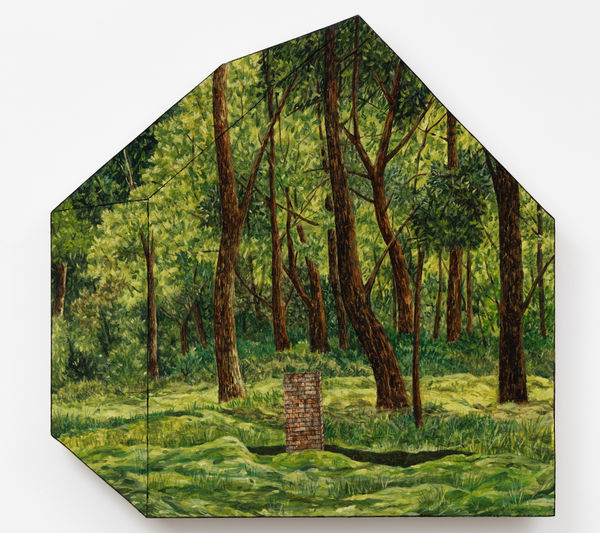
Vast mountainscapes, dense forests and winding rivers are painted onto wooden surfaces cut into uniform shapes that resemble a simple house structure, simultaneously holding and restricting the landscape. They are memories of Iranian artist Amirhossein Bayani’s homeland, psychological states, and compressed emotions. The Narrative of Minorities, Bayani’s first solo exhibition at Kristin Hjellegjerde Gallery, draws on his diasporic experiences, on the complex and ongoing journey to build a home.At a first glance, the landscapes Bayani paints seem almost paradisal, bursting with colour and life, but there is also an eeriness to the scenes. In the forest, the shades of green are vivid to the point of being luminous, the foliage so dense it creates a kind of wall, blocking out the light while elsewhere clouds and low hanging fog obscure or fragment the image. These visual barriers become symbolic for the immigrant’s struggle to envision a future when their life is ruptured by uncertainty and a feeling of precariousness. Within some of these landscapes are small structures – a tower of bricks, a concrete triangle – suggestive of failed or lost settlements, of displacement and obstruction.Each composition draws on Bayani’s own personal experiences and emotions, but they have a far wider resonance within the context of recent and ongoing geopolitical events that have placed countless lives under risk. Within this context, the painting of the mountain at sunset becomes particularly poignant. This is Damavand, a mountain that in Iran is a symbol of salvation and resistance, the image of which Bayani finds himself continually returning to. The structure at the foot of the mountain is a visualisation of the memory he carries with him, but dwarfed in comparison to the real thing, its small, fragile form speaks to the limits of memory and the inability to fully reconstruct what has been left behind.As these works acknowledge, there is a certain naivety in the idea of making a home in an unfamiliar place, but that naivety is also bound up with hope. The repeated house-like shapes of Bayani’s wooden panels articulate both desperation and determination. At the same time, they possess an almost shrine-like presence: they are keepsakes and dreams, a prayer for the future.For Bayani, these paintings are not simply about longing, but about survival. They speak to the reality of people forced to leave their homes due to political conditions beyond their control, to the emotional labour of beginning again in unfamiliar terrain. And yet, amid the density and disorientation, they also hold space for resistance – for remembering, rebuilding and imagining new ways to belong. -
Amirhossein Bayani : The Narrative of Minorities
Past viewing_room