-
Emma Talbot
Precious Metals -

-
Highlights and Collections In 2020, Emma Talbot was the winner of the 8th Max Mara Art Prize for Women. In 2018 she was awarded the Bryan Robertson Trust award. In 1995-6 she was presented with the Rome School Scholarship; supporting her study in Rome. Talbot’s work can be found in a plethora of important and private collections, which include; Arnhem Museum (Netherlands), Art Gallery of Western Australia (Perth, Australia), Arts Council Collection AzkoNobel (Netherlands), British Council Collection City of Birmingham Museum & Art Gallery (UK), Collezione Maramotti (Italy), David Roberts Collection Dodrechts Museum (Netherlands), Fried Museum (Netherlands), Guerlain Collection (Paris, France), KRC Collection (Netherlands), Kunstsammlung NRW Dusseldorf (Germany), Louisiana Museum (Denmark), University of the Arts London: Special Collections (UK), Waltham Forest Collection (UK).
-
Enquire
-
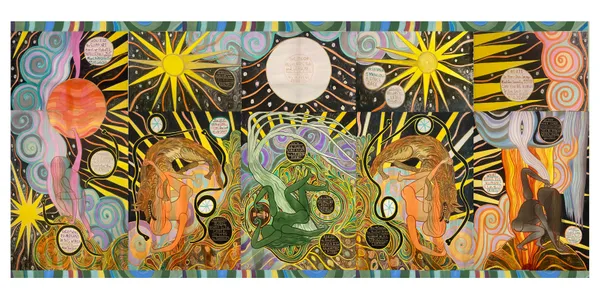
Emma Talbot, Precious Metals, 2026
-
Emma Talbot, Temporal Being, 2025
-
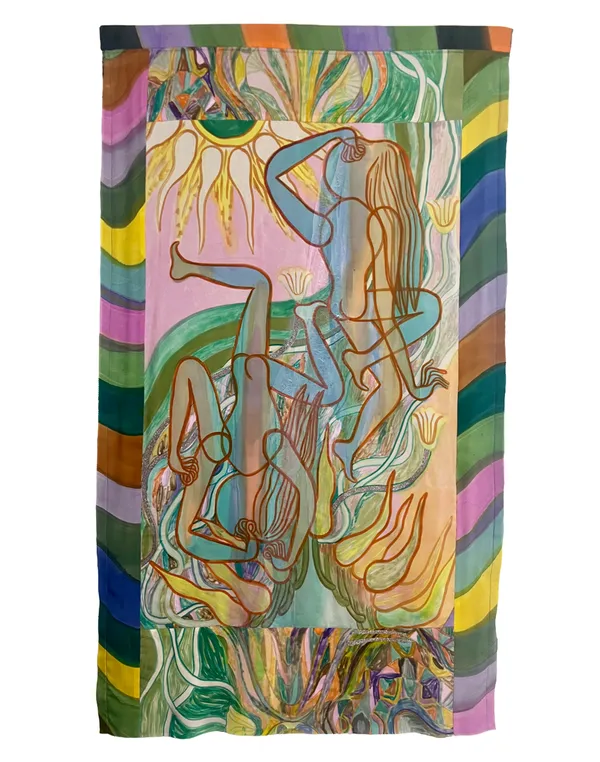
Emma Talbot, Galaxy Of Two, 2025
-
Emma Talbot, Night Flight, 2025
-
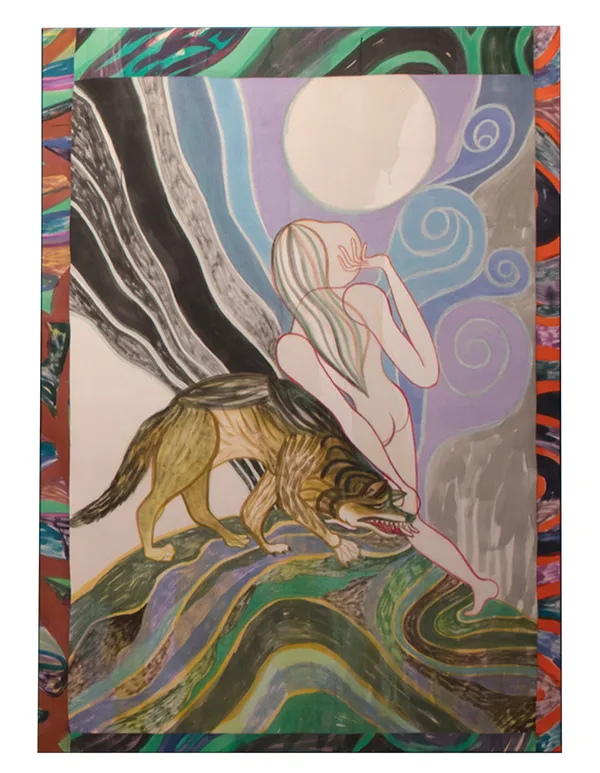
Emma Talbot, Italian Story, 2025
-
Emma Talbot, Floating World, 2026
-
Emma Talbot, Solar, 2026
-
Emma Talbot, Psyche, 2026
-
Emma Talbot, Creation Myth, 2025
-
Emma Talbot, Everything is energy, 2019
-
Emma Talbot, Interstellar, 2025
-
Emma Talbot, Song , 2025
-
-
Precious Metals
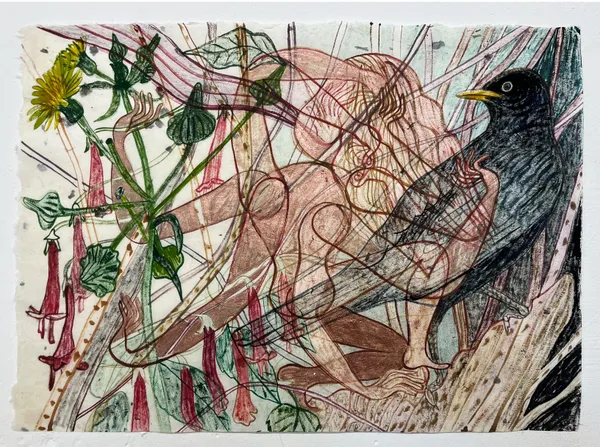
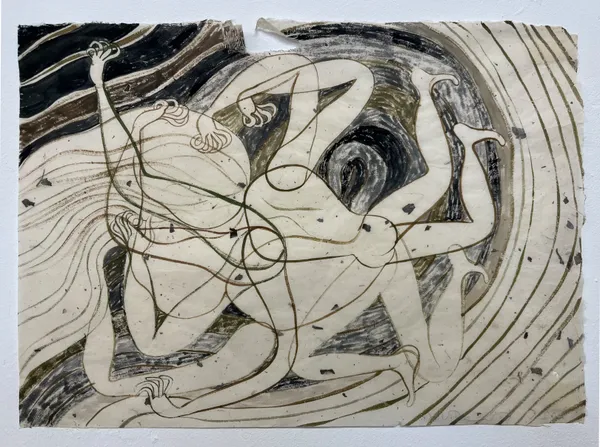
Figures tumble through glittering, kaleidoscopic worlds, their limbs merging with celestial forms, creatures and plants. These are the magical visions of Emma Talbot, whose solo exhibition Precious Metals at Kristin Hjellegjerde Gallery, West Palm Beach reflects on our rapidly changing relationship to both Earth and space.
At the centre of the show is the titular work: a large-scale, hanging silk painting that tells a contemporary story of human progress and transformation across five panels. Here, Talbot casts us into a fantastical sky, burning bright with planets, stars and rays of light. Her signature figures – which she likens to ‘rootless plants’ – become extra-terrestrial beings here, able to traverse and physically touch the planets around them, yet still tethered to their earthly origins. In two of the panels, the figure is intertwined with a wolf, while in another they appear bound up with the trunk and roots of the tree, their own skin dyed a deep green.
At the heart of this universe is the moon, a giant, seemingly untouchable presence that regulates our earthly seasons, though, as the floating orbs of text suggest, what was once distant to humanity is now within our reach. ‘Excavating, mining…wrapped up in a struggle for control’ – what Talbot is reflecting on here, in her own words painted delicately onto the translucent fabric, is a new ‘space race’: the move towards mining cosmic materials as a means of sustaining our technological advancements on Earth. Her ruminations, though alarming, are more searching than damning in tone, leading to an essential question that underpins the whole exhibition: ‘What makes you human?’
Both Solar and Floating World frame this question as inseparable from our relationship to nature. In both the paintings, the figure is falling – suspended between the scorched earth and the fiery sky, and entangled within watery plant-like forms. Here, as across all of Talbot’s paintings, the figure is both recognisably human and something other.
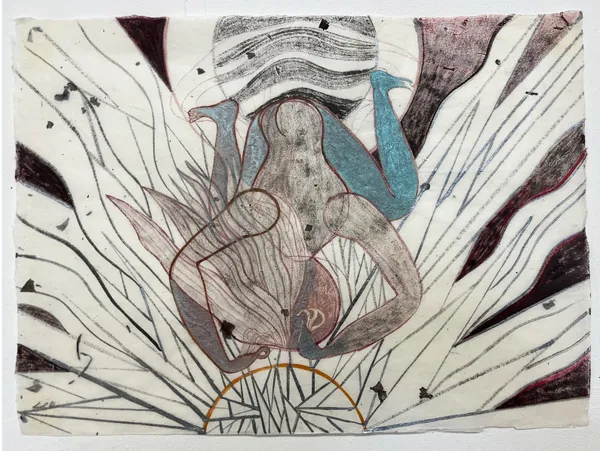
As the painting Psyche suggests, these figures possess the ability to exist in multiple times and places at once, their numerous limbs and translucent skin suggesting both movement and multiplicity. Though visually fantastical, Talbot notes that this is, to an extent, also true of humans: our minds constantly move back and forth through time, drifting beyond the present moment into memory, speculation and imagined worlds. And now, technological advances have expanded our physical mobility to such an extent that space itself increasingly feels like an extension of the human domain, leaving us to wonder: what comes next?
Throughout the exhibition, her works resist closure, inviting us to explore with her instead the ‘emotional experiences that we all share but can’t quite pin down’. Galaxy of Two, for instance, likens the connection between mother and child to something cosmic and expanding, while Italian Story explores our complex relationship to and dependence on nature.In this latter work, the wolf reappears, this time biting into the figure’s hand as they gaze up at the moon. Again, it’s a scene that suggests both a feeling of connection and threat – the world around them is on the brink of change, shifting in swirling forms and watery rivulets.
In this way, Talbot holds beauty and danger in the same hand. Rather than offering us visions of despair and destruction, she invites us to dwell in uncertainty – imagining new ways of being human at a moment when our reach extends further than ever, from the depths of the earth to the far edges of space.
-
Emma Talbot: Precious Metals
Current viewing_room