
Private View: Friday, 20th March of 2026, 6-8pm
London (Tower Bridge)
An anonymous figure, cropped from the shoulders down, sits in an armchair, dressed in a formal green tweed suit complete with waistcoat, red ribbed socks and blue Vans. Dressing for Pleasure, Luella Bartley’s latest solo exhibition at Kristin Hjellegjerde Gallery, London explores the language of fashion – how our choice of clothing communicates everything from how we move through space to the environments that surround us and our emotional states.
Previously a fashion designer, Bartley spent the first few years of her painting career literally stripping her subjects bare. She has gradually reignited her interest in clothes – how they act as a protective layer, but also as a form of self-expression. Her subjects in this show are all close friends and family members, though they continue to be stripped of context, cast into an abstract, white space so that attention is drawn less to who they are and more to how they occupy space in that moment. They are oversized figures, pushing at and sometimes beyond the boundaries of the canvas.
In one particularly striking work, a woman sits cross-legged, wearing a pin-striped shirt, leather skirt, and sheer tights, cutting a diagonal line across the centre of the canvas. Apart from the vague outline of the chair on which she sits, the space around her is left empty, though not vacant – it is charged by her presence and the tension between her clothing and posture. There is a suggestiveness and confidence in her outfit and the slight forward tilt of her left shoulder, yet her tightly crossed legs and arms suggest she is also holding something back. A similar tension is seen in another painting of a suited figure; here, the suit conceals the body, and its oversized silhouette and deep creases expand the figure’s presence in space while their pose suggests a folding inwards.
Elsewhere we encounter teenagers in dirty socks, oversized hoodies and tracksuit bottoms – outfits that aren’t designed to make a statement, but still reveal something about how these individuals exist in the world and the impression they wish to convey.
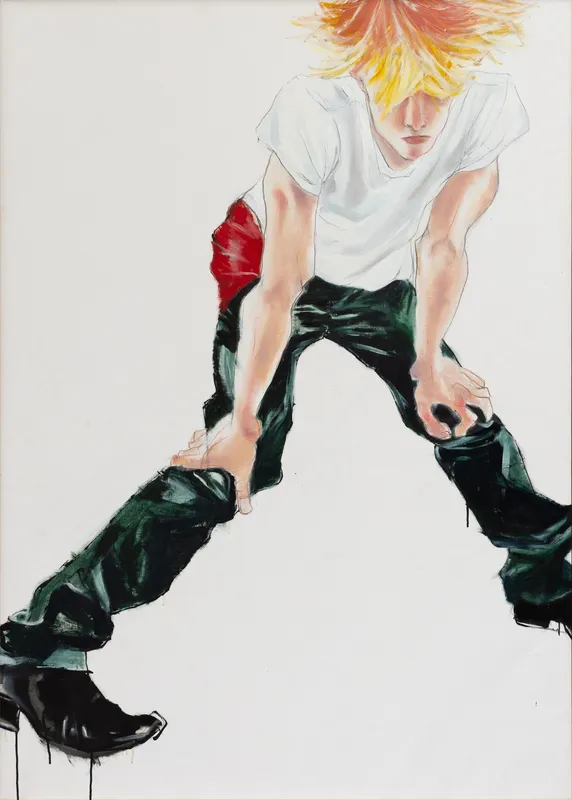
While Bartley’s early works were fraught with physical and emotional turmoil, contorted almost to breaking point, we see an openness and joy in these works, in the poses of her subjects but also in the vibrancy of her colour palette. It’s not that the struggle or the imperfections have disappeared, but here they become part of a playful performance – from the dripping paint of a boy’s heeled boots as he stretches his legs wide across the canvas to the visible smudges and sketch lines left by the artist, embracing failure as part of her process.
It’s this sense of freedom and experimentation that sits at the centre of the pleasure evoked by Bartley’s title. Seen together, these works assert themselves with confidence, flirting with our gaze and inviting us to take pleasure in the intimate act of looking.
